The Almanzora Valley ends August with some 17,800 workers registered with Social Security, up 1.2% on a year ago
Fourteen of the 27 municipalities gain registered workers. Employment is growing less than in the province of Almería as a whole, where it is up 3.4%.

Automatic translation: this article was translated with artificial intelligence from the original in Spanish. Read the original
The 27 municipalities of the Almanzora Valley ended August with some 17,800 workers registered with Social Security, around 215 more than a year earlier. That is an increase of 1.2% and the highest figure for any August in the last eight years, according to Social Security data by municipality, which elValle Actualidad has analysed town by town.
- 17,800 registered workers, in round numbers, in the 27 municipalities on the last day of August
- +1.2% in a year: around 215 more registered workers than in August 2025
- 14 of 27 municipalities have more registered workers than a year ago
Employment in the district has been rising for several years. In August 2019 there were around 15,800 registered workers. Since then, the figure for each August has risen year after year, except in 2020, the year of the pandemic, and it is now almost 2,000 registered workers higher, an increase of 12.5%.
Compared with July, the Valley lost around 280 registered workers, 1.5%. That is normal at this time of year: over the previous five years, the number of registered workers in the district fell by an average of 1.5% between the last day of July and the last day of August.
That said, the Valley is advancing more slowly than its surroundings. Using the same last-day-of-the-month data, the province of Almería ended August with 327,382 registered workers, 3.4% more than a year earlier, and Spain with 22,079,167, 2.1% more. It is not down to a single day: in June and July, the Valley also grew less than the province (2.9% and 2.0%, compared with 3.7% and 4.0%). And since 2019, compared with the Valley’s 12.5%, the province has gained 17.8% in registered workers and Spain, 14.7%.

Town by town
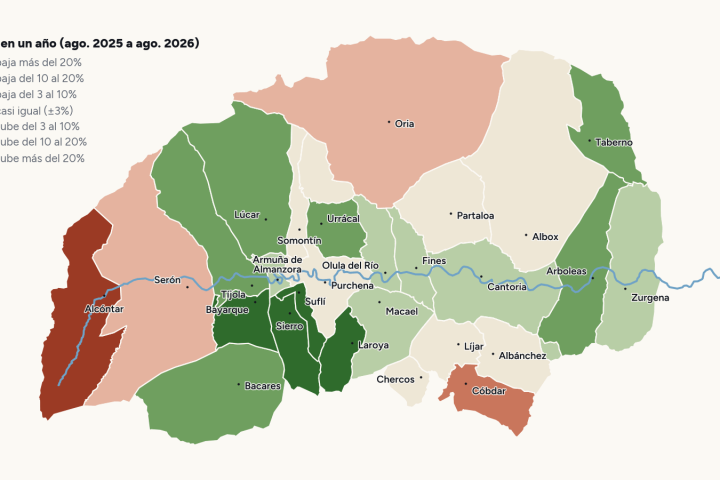
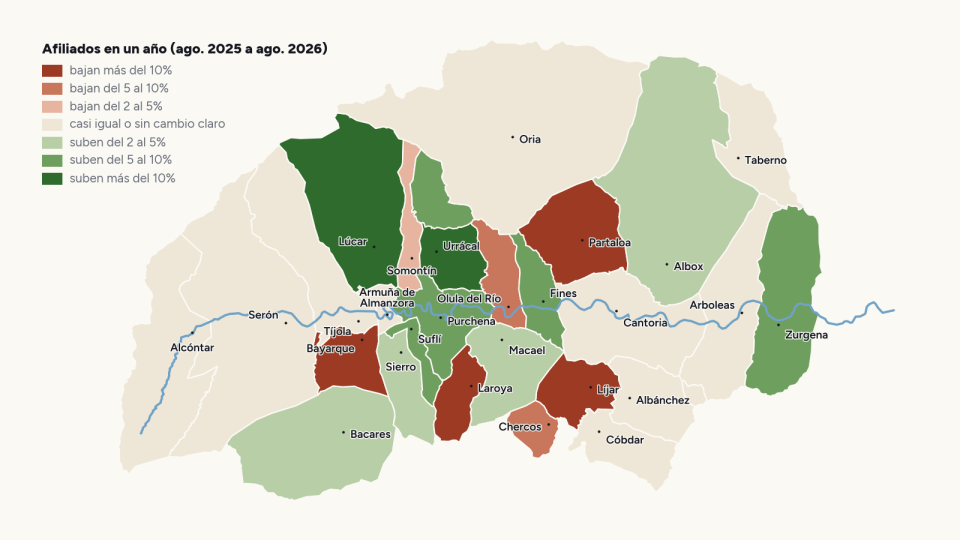
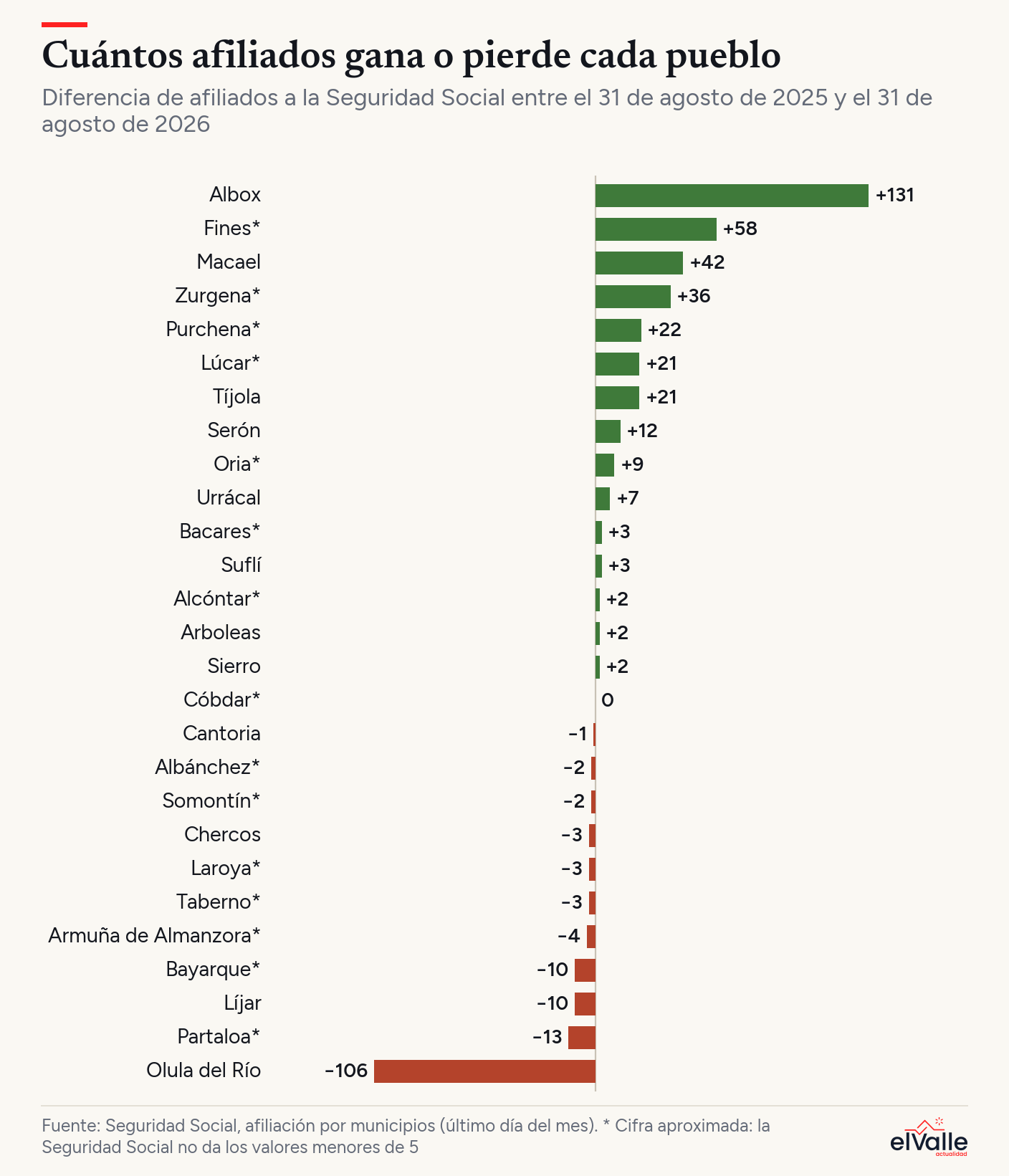
The number of registered workers rises in 14 of the 27 municipalities and falls in 9. In the other 4 (Alcóntar, Armuña de Almanzora, Cóbdar and Taberno) it is not possible to tell whether it rises or falls: the difference is within the margin of the figures below five, which Social Security does not publish. The largest increase is in Albox, with 131 more registered workers, followed by Fines (around 58), Macael (42), Zurgena (around 36), Purchena (around 22), Lúcar (around 21) and Tíjola (21).
At the other end, Olula del Río stands out, losing 106 registered workers in a year, 7%: it goes from 1,541 to 1,435. It is followed, a long way behind, by Partaloa (around 13 fewer), Bayarque (around 10) and Líjar (10). In the small villages, a few people move the percentages a lot: in Urrácal the number of registered workers rises by 16%, but that amounts to seven more registered workers.
Cantoria and Albox are by far the municipalities with the most registered workers: 4,023 and 3,982. Together with Macael (2,079), they account for 57% of the whole district. Cantoria, with 3,592 residents according to the 2025 padrón (the municipal register), has more registered workers than inhabitants. The explanation lies in how these figures are calculated: Social Security counts employees in the municipality where the company has its contribution account, not where they live.
Who contributes in the Valley
Seven in ten of the Valley’s registered workers (71%) are employees under the General Scheme (Régimen General), not counting the special systems for agricultural and domestic workers: 12,683, 194 more than a year ago. The self-employed number around 3,755, 21%, and barely change: around 30 more. The agricultural system, with around 1,227 registered workers, is the only one of the large groups that is falling: around 44 fewer in a year, while in the province as a whole it is growing by 8.7%.
The trend goes back a long way. Since 2019, the General Scheme has gained 2,327 registered workers in the Valley (22.5% more) and the self-employed around 180 (5.1%). The agricultural system, on the other hand, has lost around 550, 30.8% fewer.
The figures for your town
These are the registered workers in each municipality on 31 August, how many of them are self-employed and how the figure has changed compared with the same day in 2025.
| Municipality | Registered workers | Self-employed | Over a year |
|---|---|---|---|
| Albánchez | 147* | 52 | −2* (−2%) |
| Albox | 3,982 | 1,002 | +131 (+3%) |
| Alcóntar | 127* | 38 | +2* (+1%) |
| Arboleas | 810 | 241 | +2 |
| Armuña de Almanzora | 29* | 15 | −4* |
| Bacares | 76 | 18 | +3* |
| Bayarque | 23* | 10 | −10* |
| Cantoria | 4,023 | 257 | −1 |
| Chercos | 56 | 28 | −3 |
| Cóbdar | 22* | 3* | = |
| Fines | 846* | 194 | +58* (+7%) |
| Laroya | 16 | 5 | −3* |
| Líjar | 71 | 22 | −10 |
| Lúcar | 218* | 64 | +21* (+11%) |
| Macael | 2,079 | 375 | +42 (+2%) |
| Olula del Río | 1,435 | 409 | −106 (−7%) |
| Oria | 657 | 171 | +9* (+1%) |
| Partaloa | 114* | 47 | −13* (−10%) |
| Purchena | 341* | 96 | +22* (+7%) |
| Serón | 689 | 127 | +12 (+2%) |
| Sierro | 49 | 14 | +2 |
| Somontín | 54* | 15 | −2* |
| Suflí | 36 | 15 | +3 |
| Taberno | 174* | 83 | −3* (−2%) |
| Tíjola | 1,222 | 267 | +21 (+2%) |
| Urrácal | 51 | 12 | +7 |
| Zurgena | 470 | 175 | +36* (+8%) |
| Almanzora Valley | 17,813* | 3,755* | +215 (+1.2%) |
elValle Actualidad will follow these figures, which Social Security updates every month, so that you can check how employment is changing in your town.
How we did it
We have added up the registered workers in the 27 municipalities of the Almanzora Valley that Social Security publishes in its municipal statistics “Total afiliados por régimen” (total registered workers by scheme), with data for the last day of each month. We compare 31 August 2026 with the same day in 2025 and in previous years since 2019, and with 31 July. We have also looked at June and July to check that the trend does not depend on a single day.
Employees are counted in the municipality where the company has its contribution account, which is not always where they work or where they live; the self-employed, in the municipality where they reside. That is why there are towns with more registered workers than residents, and a change of account between two towns can shift a lot of registered workers at once. In addition, the statistics count registrations, not people: someone who has two jobs, or is both an employee and self-employed at the same time, counts twice.
Social Security does not publish figures below five for each scheme in a municipality. Those cells are worth between 1 and 4, so some totals are approximate: the Valley’s total on 31 August was between 17,793 and 17,832 registered workers. We give the midpoint and mark approximate figures with an asterisk.
The figures for the province and for Spain come from the same file and are also for the last day of the month, so that like is compared with like. That is why they do not match the average registration figures released by the Ministry of Inclusion, Social Security and Migration: in August, 330,679 registered workers in Almería and 22,345,226 in Spain. We do not calculate registered workers per inhabitant: under this criterion, that division would give a misleading picture.
Sources consulted
- Social Security, registered workers by scheme and municipality (last day of the month)
- Social Security, municipal file of registered workers for August 2026
- La Moncloa, report on Social Security registrations for August 2026
- Teleprensa, August unemployment and Social Security registrations in the province of Almería
- INE, official population figures for the municipalities of Almería (padrón as of 1 January 2025)
- Murcia Regional Statistics Centre, methodology of the statistics on registered workers (the Ministry’s municipal criterion)