Average declared income in the Almanzora Valley rises 5.4%, but is still almost €10,000 below Spain’s
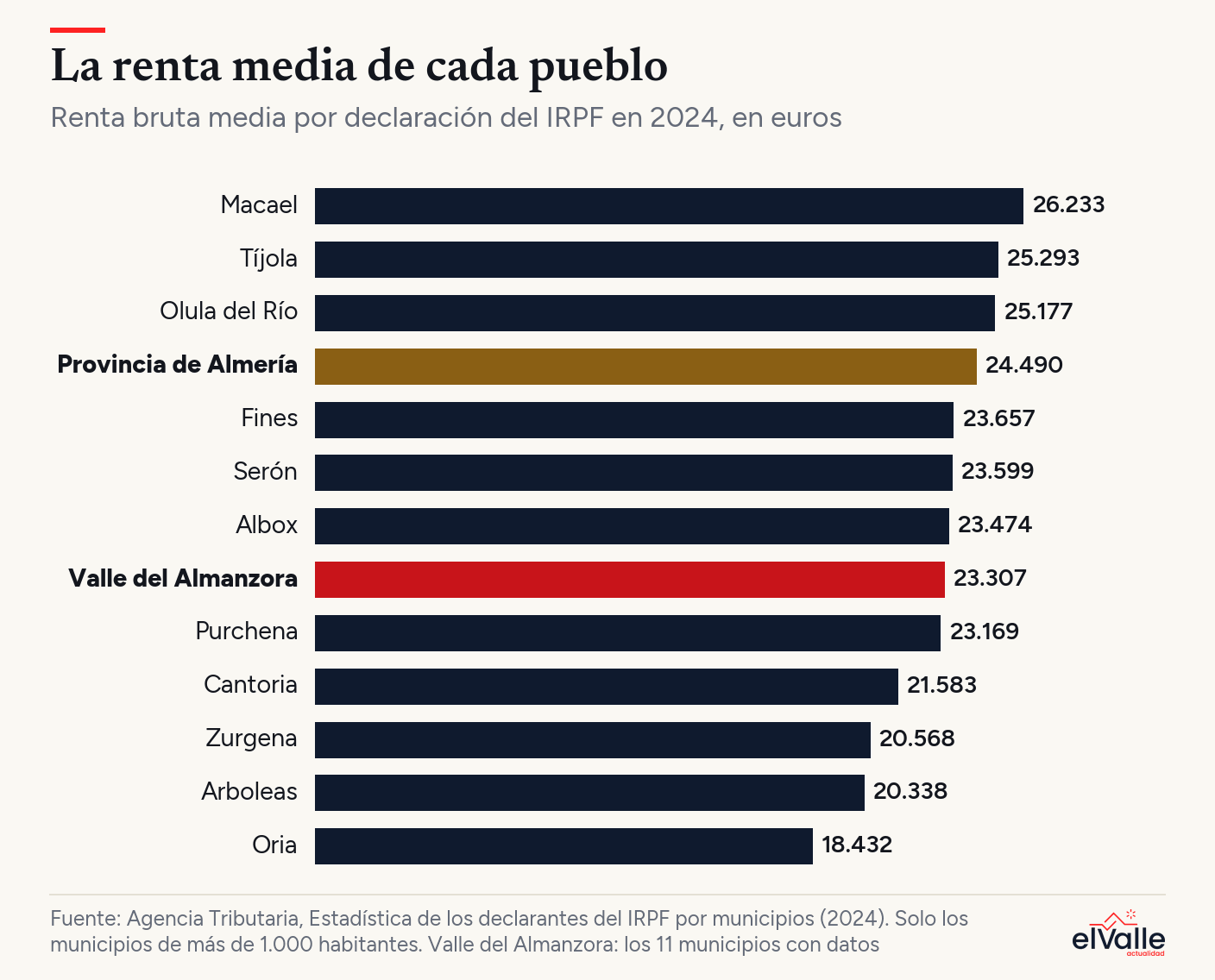
Macael, with €26,233, tops the 11 municipalities with Tax Agency data and Oria, with €18,432, comes last. All of them improve on 2023, and by more than prices rose.

Automatic translation: this article was translated with artificial intelligence from the original in Spanish. Read the original
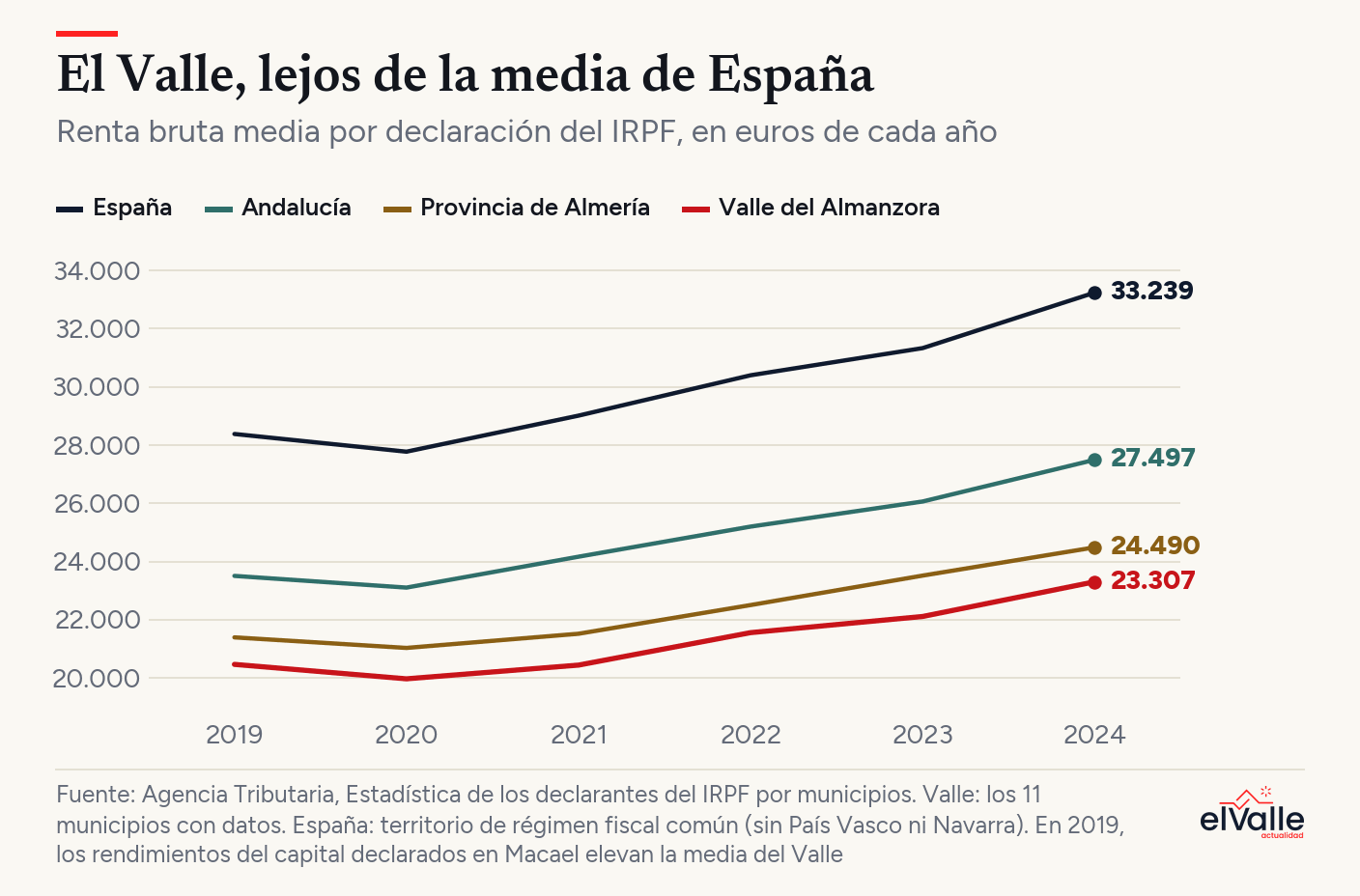
Each income tax return in the Almanzora Valley declared an average of €23,307 gross in 2024, €1,191 more than a year earlier. That is a rise of 5.4%, almost double the rise in prices, which went up by an average of 2.8% that year according to the INE (National Statistics Institute). These are the Spanish Tax Agency (Agencia Tributaria) figures published this week, which elValle Actualidad has analysed town by town.
- €23,307 average gross income per tax return in the Valley’s 11 towns with Tax Agency data
- +5.4% in a year, compared with a 2.8% rise in prices
- €9,932 less than the Spanish average, which reaches €33,239
The improvement is not enough to close the gap with the rest of the country. The Valley average is €1,183 below that of the province of Almería (24,490), 4,190 below the Andalusian average (27,497) and 9,932 below the Spanish one (33,239). It is equivalent to 70% of the Spanish average, and that gap is growing: in 2023 it was €9,217.
With the province, the opposite is happening. Income in the Valley has risen more than in the province of Almería as a whole, where it grew 4.1%, and the gap has narrowed from €1,404 in 2023. Andalusia (5.5%) and Spain (6.1%), on the other hand, are moving ahead faster.
Town by town
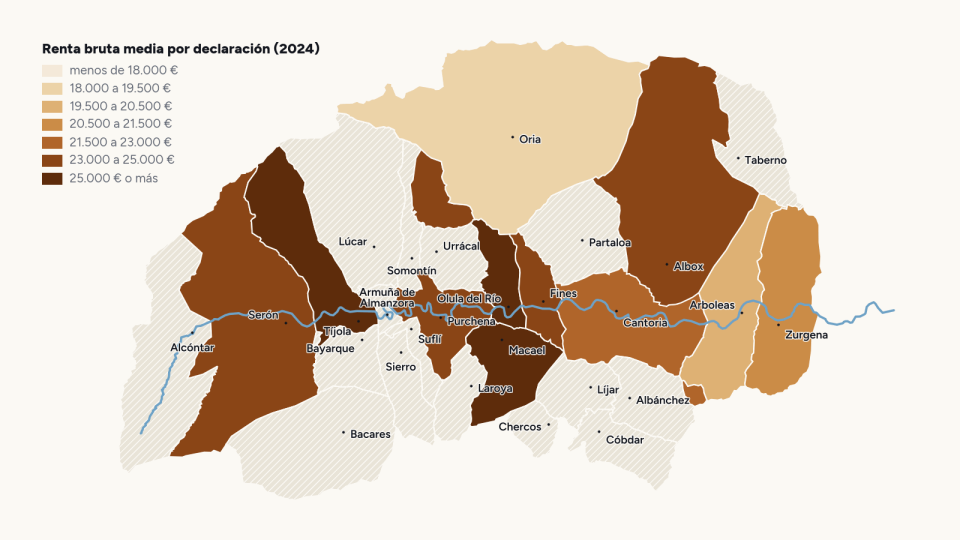
Macael, with €26,233 per return, is the town in the Valley with the highest average income and fifth of the 52 municipalities in Almería with their own data, behind only Almería, Mojácar, Huércal de Almería and Carboneras. It is followed by Tíjola (25,293) and Olula del Río (25,177), in 7th and 8th place in the province, the other two towns in the district above the provincial average.
Next come Fines (23,657), Serón (23,599), Albox (23,474) and Purchena (23,169). Cantoria (21,583), Zurgena (20,568) and Arboleas (20,338) are further down, and Oria comes last with €18,432, 7,801 less than Macael and in 47th place in the province.
Average income rises in all 11 towns, and in all of them by more than prices. Serón, Tíjola, Zurgena and Arboleas lead the rises, at around 7%. Olula del Río grows the least: 4%.
Where the income comes from
In the Valley, income depends more on work than in the rest of the province. More than eight in every ten euros declared (83.1%) is income from work, which for personal income tax purposes includes wages and also pensions. In the province of Almería it accounts for 77.5% and in Spain, 77.3%. The business activities of the self-employed, farmers and professionals contribute 6.1% of income in the Valley, compared with 10.3% in the province.
After paying the tax and Social Security contributions, each tax return in the Valley is left with an average of €19,557 in disposable income, 4.8% more than in 2023.
The Tax Agency only publishes separate figures for municipalities with more than 1,000 inhabitants. The Valley’s other 16 villages, from Albánchez to Urrácal, home to 13% of the district’s population, are added together with the rest of the province’s small municipalities: taken together, the 51 municipalities in Almería with fewer than 1,000 inhabitants declare an average of €19,841.
The figures for your town
This is the average income in each municipality with its own Tax Agency data in 2024, and how it has changed compared with 2023.
| Municipality | Tax returns | Average gross income (€) | Average disposable income (€) | Over a year |
|---|---|---|---|---|
| Albox | 5,788 | 23,474 | 19,710 | +6% |
| Arboleas | 2,169 | 20,338 | 17,569 | +7% |
| Cantoria | 1,698 | 21,583 | 18,337 | +4% |
| Fines | 1,083 | 23,657 | 19,639 | +4% |
| Macael | 2,594 | 26,233 | 21,555 | +4% |
| Olula del Río | 3,251 | 25,177 | 20,769 | +4% |
| Oria | 1,023 | 18,432 | 16,128 | +5% |
| Purchena | 719 | 23,169 | 19,345 | +6% |
| Serón | 975 | 23,599 | 19,770 | +7% |
| Tíjola | 1,704 | 25,293 | 20,876 | +7% |
| Zurgena | 1,547 | 20,568 | 17,926 | +7% |
| Valley (11 municipalities) | 22,551 | 23,307 | 19,557 | +5.4% |
elValle Actualidad will return to these figures when the Tax Agency publishes the 2025 data, so that you can follow how income is changing in your town.
How we did it
We have used the Spanish Tax Agency’s statistics on personal income tax (IRPF) filers by municipality, with the data for 2024 (the income tax returns filed in 2025), published on 30 September 2026. Average gross income is the gross income declared divided by the number of returns; a joint return counts as one. Disposable income subtracts the tax due and Social Security contributions.
The Tax Agency only gives separate data for municipalities with more than 1,000 inhabitants: in the Valley, 11 of the 27, home to 86.9% of the population according to the INE’s 2025 municipal register (padrón). The Valley average is our own calculation: we have added up the gross income and the returns of those 11 towns. Spain here means the territory under the common tax regime, excluding the Basque Country and Navarre, which have their own tax authorities.
The amounts are in euros of each year, without adjusting for inflation; for comparison, we give the INE’s average rise in prices (CPI). Only those who file a return are counted, and many people on low incomes are not required to do so: that is why these averages are not the income of all residents and cannot be compared with the INE’s household income atlas (Atlas de renta). We mainly compare with 2023 because in 2019 the capital income declared in Macael (€19.8 million, compared with €2.4 million in 2020) pushes up the Valley average.
Sources consulted
- Spanish Tax Agency (Agencia Tributaria), statistics on personal income tax (IRPF) filers by municipality, 2024
- Spanish Tax Agency, 2024 data for the province of Almería and its municipalities
- Spanish Tax Agency, methodology of the statistics
- INE (National Statistics Institute), Consumer Price Index, national general index (series IPC251852)
- INE, official population figures for the municipalities of Almería (padrón as of 1 January 2025)