When it rains, migas: the story of Carolina Carrillo and the Taberno workshop now part of Sabores Almería
In Taberno, a village of 955 residents, Carolina Carrillo runs a workshop making artisan migas that have reached Murcia and Baza and are now part of Sabores Almería.

Automatic translation: this article was translated with artificial intelligence from the original in Spanish. Read the original
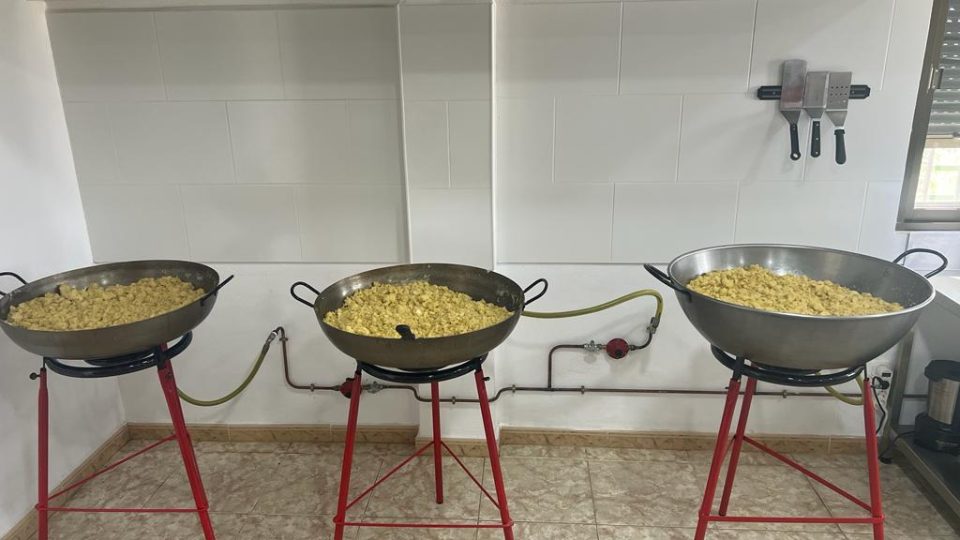
When it rains in the Almanzora Valley, it smells of migas (a traditional crumb dish). And this weekend the rain is back: the DANA (a cut-off low) forecast since Tuesday is arriving, and AEMET, Spain’s state weather agency, has activated a yellow warning for rain and storms on Saturday in the Almanzora Valley and Los Vélez. In many homes, thoughts are already turning to the paella pan. In Taberno, a village of 955 residents, migas even have their own workshop, and on one of its white walls black letters say it plainly: “Obrador. Fábrica de migas” (Workshop. Migas factory).
Behind that sign is Carolina Carrillo. In March 2025, Almería Provincial Council introduced her as “one of its managers”, and Turismo Almanzora, the website of the Asociación de Empresarios Turísticos del Valle del Almanzora (Almanzora Valley Tourism Business Association), describes her as “the proud owner of the Obrador de Migas de Taberno”. Her company, the provincial institution explained at the time, prepares and markets one of the most typical dishes of Almería: “traditional migas made by hand, just as anyone can prepare them at home”.
Flour, water, oil and salt
They are flour migas, as the label says. Turismo Almanzora counts them among Taberno’s emblematic dishes, explains that they “are made with wheat flour” and adds that they allow for “numerous flavours, so that everyone can have their favourite migas”. On the packaging that can be seen in the photos on its listing, the ingredients fit on a single line: wheat flour, salt, virgin olive oil and water.
They leave the workshop freshly made, in small or large portions, and in five-kilo sacks intended for the hospitality trade and fairs, according to that same listing.
From Taberno to the province’s brand
In March 2025, when the Provincial Council visited the company, Migas de Taberno was already being distributed to the hospitality trade, supermarkets and food shops in the province, in some municipalities in the Region of Murcia and in the Baza area. At that time, according to the institution, they were considering “formalising their membership” of Sabores Almería, its gourmet brand, and “expanding their sales channels”.
In December that year, Migas de Taberno was already among the 38 companies of the brand offering their products at the Sabores Almería fair, in the Plaza de las Velas in the provincial capital. And in 2026, the Provincial Council has announced it among the six companies at the Sabores Almería market during the capital’s Noche en Blanco (White Night), in May, and among the brand’s 19 companies at the Macenas Blue Nights in Mojácar, in July.
Not forgetting the fairs at home. According to La Comarca Noticias’ reports, it had a stall at the second edition of ‘Albox con Mucho Gusto’, in December 2024, and at the first edition of ‘Saboriza’, in Zurgena, in May 2025. In December 2025 it was also among the businesses at the Christmas Market for Equality (Mercadillo Navideño por la Igualdad) in Arboleas. And since 2024 a tub of its migas has been part of the prize hamper of the Ruta de Sabores del Almanzora (Almanzora Flavours Route), organised by the Valley’s Tourism Business Association. This October, in its fourth edition, it is once again among the products from the 23 producers in the area that make up that hamper, according to Turismo Almanzora.
A dish for shepherds and rainy days
The custom goes back a long way. As we have already reported in elValle Actualidad, until the 20th century migas were considered a dish for shepherds and farmers, who carried garlic, oil, bread and flour in their knapsacks and, if it rained, took shelter in caves, cortijos (farmhouses) or pens to light the fire and cook them. And in a land of so much sun, rain is still celebrated with the family gathered around the paella pan.
Why it matters in Taberno
That is why it is valuable that this dish has a workshop in Taberno, and that its brand carries the village’s name wherever it goes: to the capital, to Mojácar, to the Region of Murcia or to the Baza area. In a municipality that had 1,205 residents in 2011 and 955 at 1 January 2025, according to the INE, Spain’s National Statistics Institute, every project that puts down roots in the village counts.
From elValle Actualidad, we can only celebrate that a dish for shepherds and rainy days now leaves Taberno with the village’s name on the label.